Skip to content


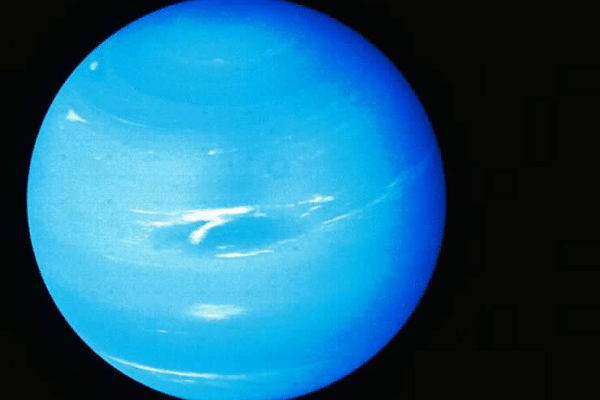
Uranus, the seventh and third largest planet of our solar system, was discovered on 13 March 1781 by the British astronomer William Herschel. It was the first planet to be discovered with a telescope – a planet that Herschel himself built. While Uranus had been seen before its official discovery (it is visible to the naked eye), it was assumed to be a star since it is dark compared to other planetary bodies and has a very slow orbit compared to Earth. Uranus takes 84 Earth years to complete one orbit around the Sun. In fact, Uranus was first seen, as we know for sure, long before it was categorized as a planet. It was recorded by the ancient astronomer Hipparchus around 128 BC, where it was likely included in his star catalog. However, even Herschel, who had an early telescope, initially believed Uranus was a comet.
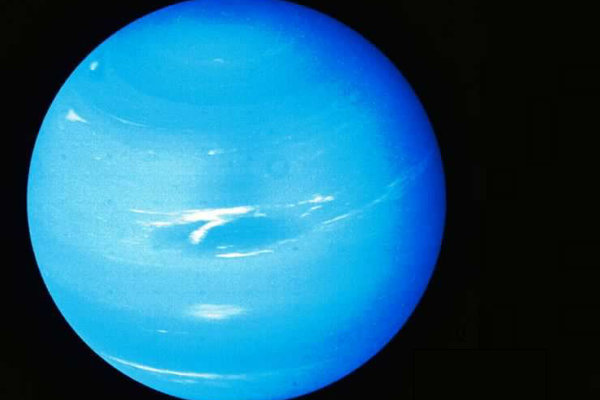
Even though he continued to believe that Uranus was a comet, other astronomers began to burden his discovery with other ideas. Unlike Johan Lexell, who was the first to calculate the planet’s orbit around the Sun. Since its orbit was nearly a perfect circle, he was convinced it was a planet and not a comet. After two years of consideration, everyone (including Herschel) accepted that Uranus was a new planet, thus expanding the realms of our solar system.
Herschel initially named his planet Georgium Sidus, which translates to ‘The Georgian Planet’. It was named in honor of the then English king, King George III. This name was not widely accepted in areas outside Britain, and other astronomers began to suggest alternatives. The name Uranus was only widely adopted in 1850 after the astronomer Johann Elert Bode suggested that its name be better aligned with the existing planets, which were also named after Greek and Roman gods and goddesses. Uranus was the grandfather of the god-king Zeus and the first planet to be named after an exclusively Greek god.
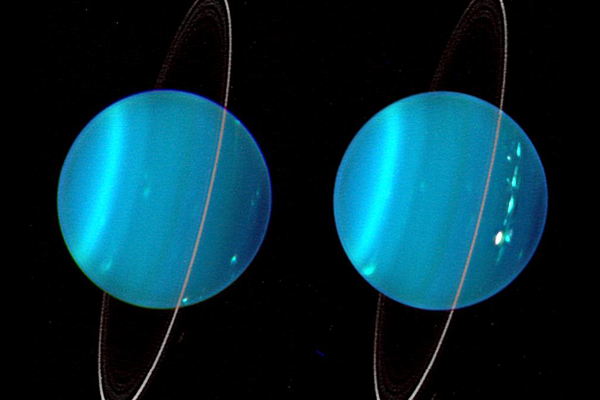
Uranus has numerous rings like Saturn. Although Herschel reported having seen rings, they were very hard to discern, hence it is generally assumed that he must have seen something else. The rings of Uranus were only truly discovered in 1977. Uranus has 13 different rings, each of which is very dark and thin. It is believed that its rings were originally moons that were shattered by the gravitational pull of Uranus. Its rings appear to be made up of larger dark rock fragments rather than dust.
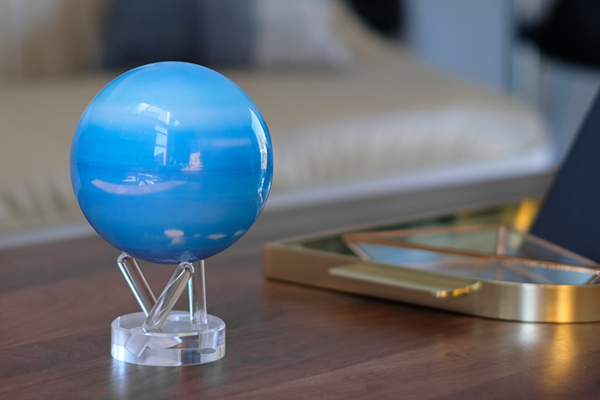
Uranus is known as the ‘Ice Planet’. It has a bright blue color that gives it a unique appearance compared to other planets. When it is dark, it is one of the most beautiful in the solar system. This is one of the reasons why we finally created our Uranus-Mova-Globe. It was created with real satellite images and shows a realistic view of Uranus from space. It is the last planet needed to create the entire solar system with our rotating MOVA globes, and we could not be more excited to offer this beauty to astronomy fans and collectors alike.