Skip to content


A Brief History of Globes
Globes can generally be divided into two main categories: terrestrial and celestial globes. A terrestrial globe represents a spherical map of the Earth, while celestial globes depict stars spherically, using the Earth as an imaginary center of the universe.
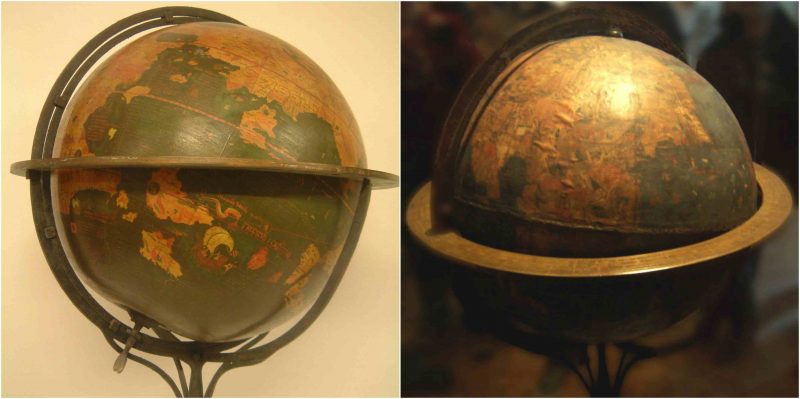
During the European Renaissance, technological advancements such as printing led to a rapid development in globe making. The German geographer Martin Behaim created the oldest surviving globe around 1492. Behaim’s globe, known as Erdapfel, German for Earth apple, is a terrestrial globe that does not include America. The globe also shows an enlarged Eurasian continent with an empty ocean between Europe and Asia. The reason the Erdapfel does not show America is that Christopher Columbus returned to Spain in March 1493 after Behaim had created his map of the Earth.
The origins of modern terrestrial globes trace back to the Flemish cartographer, mathematician, astronomer, and engraver Gerardus Mercator from the mid-16th century. The Mercator projection is primarily known for the Mercator projection, where all meridian and longitude lines run parallel and latitude lines intersect at right angles and run parallel to each other. Mercator’s projection simplified map reading, as researchers could plot a ship’s course between any two points in a straight line and follow that course without changing the compass direction.
The Materials Used to Make Terrestrial and Celestial Globes
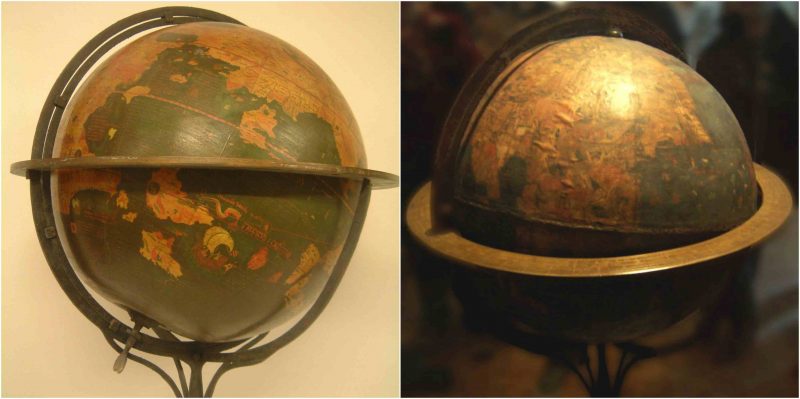
Ancient globes were made from various materials. For the Erdapfel, a laminated linen sphere is split in two halves. The globe is reinforced with wood and covered with a sectionally painted map. The map is drawn on paper and then glued onto a parchment layer around the globe.
Some terrestrial globes existed earlier than the Erdapfel and were made from solid materials like glass, marble, wood, and metal. Early celestial globes were typically made of metal and often crafted by silversmiths and engravers.
Modern globes are almost always hollow and made from durable and lightweight materials, including cardboard, plaster, plastics, or metals. Unlike vintage globes, modern globes can be more accurately balanced to ensure smooth rotation.
The Antique Terrestrial Globe by Cassini
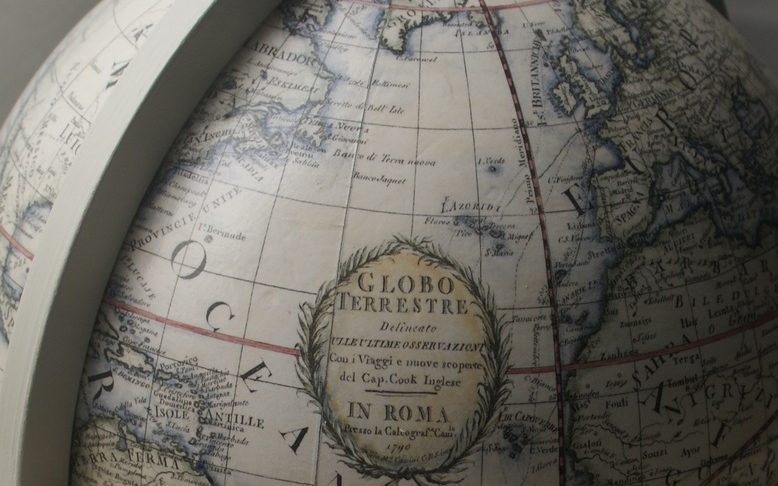
In 1790, the prolific engraver and cartographer Giovanni Maria Cassini created a new terrestrial globe based on the latest geographical discoveries. Unlike many other globes of this time, Cassini’s terrestrial globe design included routes from the daring voyages of the late Captain James Cook. These voyages, which began in 1768 and ended with Cook’s death in 1779, were still young and of great interest to Europeans when the globe was made.
Design and Geographical Content
Three differently colored lines wound around the globe, representing the routes and dates of Cook’s adventures up to his tragic end off the coast of Hawaii. Although Cassini’s design was not the first to include Hawaii, the islands were still a new discovery and would have been an exciting addition. Cook and his crew first arrived in Hawaii in 1778 during their final expedition, referred to on the globe as Owyhee.
Similarly, New Zealand was a new discovery and was depicted worldwide as a center of activity during each of Cook’s voyages. During his first voyage, Cook discovered the islands and spent months carefully mapping the area. Not included on the map is the continent of Antarctica, which was fully discovered only thirty years after the globe’s creation. On his second voyage, Cook ventured into the icy waters of the polar circle but could not find the great southern continent.
The globe also included the United States as a small country on the East Coast. An ecliptic line also extends around the globe, indicating the position of the sun as the Earth rotates on its axis.
Cassini gathered most of his geographical information for the globe from other maps and atlases. He cited works published by the Academy of Sciences and a well-known French cartographer, Robert de Vaugondy.
Cassini’s Terrestrial Globe Publication
Cassini’s terrestrial globe was published in 1792 as a series of twelve large segments in his most popular work, an atlas titled Nuovo Atlante Geografico Universale. This atlas, the first of three volumes, also included a set of twelve segments for a celestial globe. Globe makers often produced pairs of terrestrial and celestial globes at that time, illustrating the arrangement of known constellations. Cassini included detailed instructions for assembling both globes. Each finished globe had a diameter of 34 cm. In addition to the two globe sets, the atlas contained large maps of the known continents, hand-colored borders, and over thirty maps of Italy and surrounding areas.
Giovanni Maria Cassini, The Man Behind the Globe
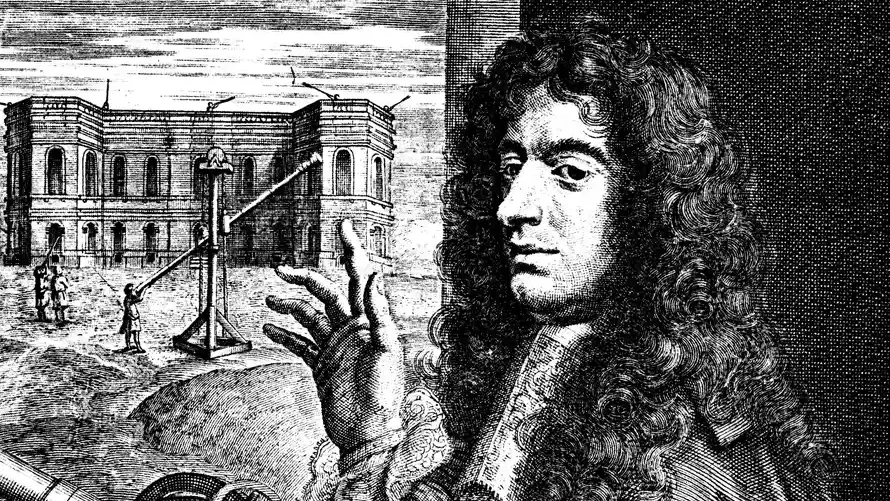
Cassini was born in 1745 in Rome, Italy. He is considered one of the last great Italian globe makers of the 18th century. He left behind an extensive body of over 780 works, ranging from globe segments to maps, diagrams, and city illustrations. Cassini was highly talented and was involved in every phase of the production of his projects before they were printed. He drew and engraved his own designs and learned from some of the best engravers and artists like Giovan Battista Piranesi. He was referred to as an engraver of perspectives and architecture.
Cassini greatly admired the British explorer James Cook and several European astronomers. He created some influential maps and globes during a time of upheaval in Europe. Borders were redrawn due to the French Revolution and the conquests by Napoleon. His globes also significantly contributed to the emergence of Italian nationalism. Cassini’s globes provide interesting insights into the politics of Rome and the military occupations of the Papal States. Today, Cassini’s globes can be seen in museums around the world.
Is It Worth Collecting Antique Globes?
There are many collectors of antique globes. The value of antique globes varies depending on their age and condition. For example, a 30-inch globe from the 1930s can be worth several thousand dollars. Collectors of antique globes determine the value of a terrestrial or celestial globe based on several factors, including the year of manufacture, the material used to make the globe, the manufacturer of the globe, the type of its mounting, and the condition of the globe. Antique globes are also evaluated based on the information found on a globe. For instance, does the globe show borders and countries that no longer exist in the world? Such globes may be worth more than modern ones with politically correct borders and country names.
To determine if your antique globe is worth something, you must first find out everything about your globe. Then, look for collectors and appraisers of antique globes to find out if the antique terrestrial or celestial globe you have has monetary value.
The Antique Terrestrial Globe by MOVA
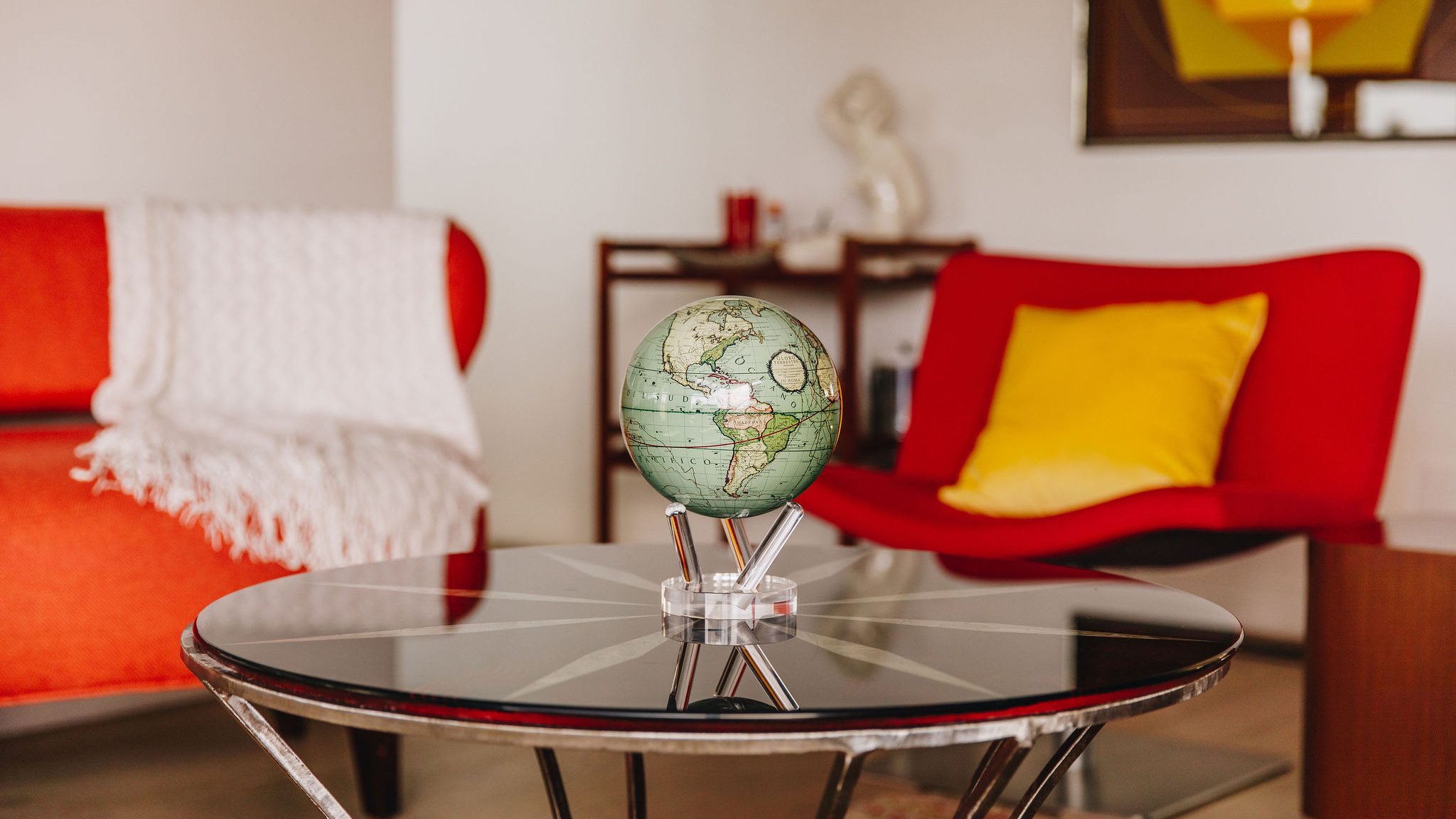
With the white or green antique terrestrial globe MOVA, you can now own a piece of history. Our striking antique globes feature two designs in fresh white or cool seafoam green, showcasing the vintage map by Giovanni Maria Cassini from 1790.