Skip to content



When the sun sets, constellations and shooting stars shine. They tell ancient stories, carry the origins of the galaxy through the cosmos, and play an important role in our past, present, and future.
A part of this vast treasure of knowledge was mapped by ancient astronomers who created celestial globes. These globes were made long before planetariums and satellites; they were our first spherical star maps.
Celestial Globes
Celestial globes were designed and mapped with the Earth at the center of the universe and were first created in the 6th century BC by the ancient Greeks. Celestial globes map the stars in the night sky by arranging them into constellations as they would appear to observers on Earth. Points, stars, or holes often mark individual stars. If the globe were equipped with an opening for a light source, the stars would be projected onto a dark surface, creating a rudimentary planetarium.

Over time, many incarnations of celestial globes have been made, and our modern version is the MOVA Constellations Globe (see image above). This globe depicts the 88 constellations recognized by the International Astronomical Union with silver points, star shapes, and lines over a deep black – and always cloudless – night sky.
What are Constellations?
There are billions of stars in the night sky, and for centuries, people around the world – from the ancient Greeks and Romans to Indian, Asian, and African cultures – have grouped stars into images. These images are known as constellations and have conveyed stories and religious significance throughout history. At the same time, they served as navigation aids for sailors and reminders for farmers about seasonal planting. Their combined stories shape our history on Earth.
Today, there are 88 officially listed constellations. The most well-known are Orion, Ursa Minor, and Ursa Major. You might be tempted to name the Big Dipper in this list. Although it is the most commonly known star pattern, it is not a constellation! It is an asterism (or a prominent group of stars) that is part of Ursa Major.
The stars in a constellation do not share the same plane in space. Their distances vary by millions of light-years. Furthermore, a star’s brightness does not determine its distance from Earth. Brightness is directly related to the size of a star. Therefore, the brightest stars can be among the farthest in a constellation.
The rotation of the Earth affects our ability to see certain constellations at different times. Farmers used these changes to determine when to plant and harvest. This also means that the stars in space remain fixed while we move. The North Star is a prime example. No matter where you are in the Northern Hemisphere, the North Star is visible and fixed above the North Pole. So, if you follow the North Star, you will always lead north.
The Stories Constellations Share
Each constellation has a name and an associated story. Some have their roots in mythology, while others are connected to religion or have astrological significance.
Some famous examples are:
Andromeda: Andromeda was born as the daughter of Cassiopeia and King Cepheus, and to appease the gods, she was chained to a rock to be fed to a sea monster. Fortunately, Perseus was so captivated by Andromeda’s beauty that he saved her. Such is the greatness of her story; it lives on forever in the night sky.
Crux (Southern Cross): While there are slight variations in different cultures, the cross is traditionally attributed a biblical significance related to the crucifixion of Jesus. Farmers also used the Southern Cross to signal the start of the planting season, as it became visible in late spring.
Ursa Major (Great Bear): This constellation refers to Greek mythology and is mentioned in the Old Testament and contains the Great Wagon. The Great Wagon is used by many as a navigation aid to find the North Star. During the time of the Civil War, enslaved people even used it in their search for freedom.
History of Shooting Stars
Stars are not the only celestial bodies visible in the night sky. For millennia, people have looked up hoping to see a shooting star. Their seemingly random and fleeting appearance at night has led to a variety of theories about their existence.
For Native Americans, shooting stars were seen as a harbinger of war. The ancient Greeks believed so strongly in the power of shooting stars that they named Asteria the goddess of shooting stars. Today, we know their symbolism and the saying that one should make a wish on a ‘shooting star.’
The Science of Shooting Stars
Scientifically speaking, shooting stars are meteors. They leave a streak in the night sky as they ignite in flames through the heat of the Earth’s atmosphere. Meteors were meteoroids – tiny pieces of asteroids or comets – that carried the origin of the universe in their rocky mass. When meteors detach from larger asteroids or comets, they leave their orbit and circle through the solar system until they collide with another planet or burn up upon entering its atmosphere.
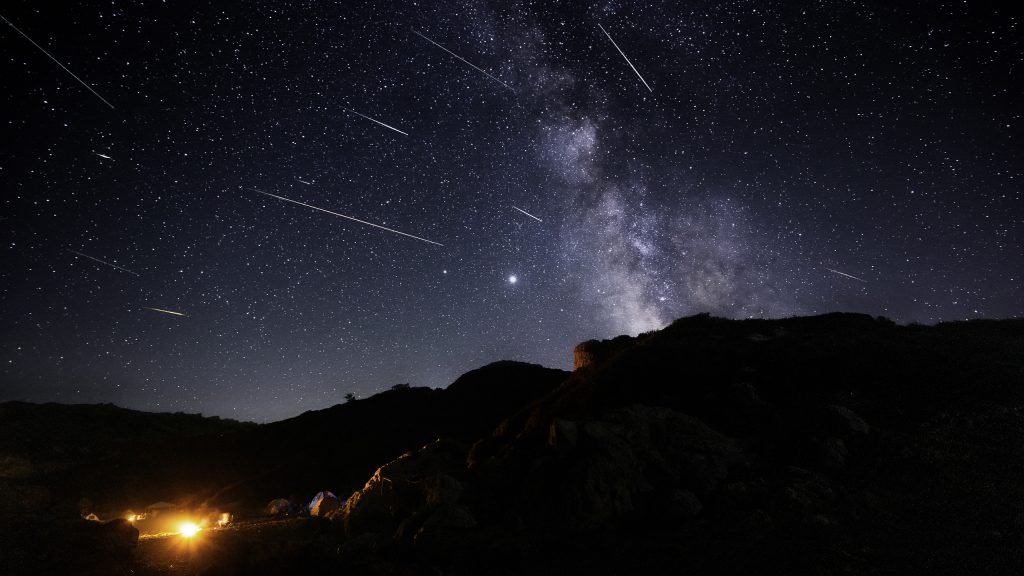
Meteor showers are celestial events in the night sky where multiple meteors (shooting stars) enter the Earth’s atmosphere simultaneously or within a few hours. Meteor showers are caused by debris trails left by comets as they pass in near-Earth orbits, making their arrival predictable using science and technology. Astronomers use this information to create calendars with dates and locations where meteor showers can be best observed.
Whether you believe in their myths and legends, use them for navigation, or simply enjoy finding them on a constellation globe and in the night sky, constellations and shooting stars will continue to bring people together as we learn more about them, our past, and our dreams for the future.