Skip to content



Sailing in the 18th century was no easy task. Sailors did not have GPS, radar, or weather forecasts. They had no way to communicate instantly with people on land or nearby. They faced storms, rough seas, and a lack of food when the journey took longer than expected.
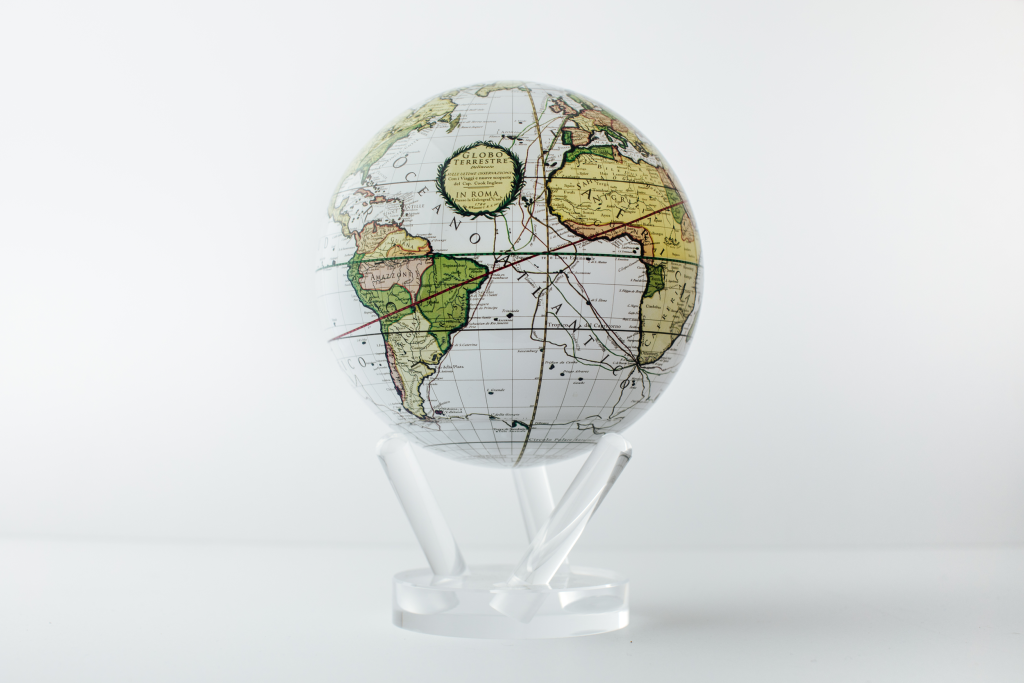
By 1790, Captain James Cook had circumnavigated and charted the world three times for the Royal British Navy. His historic voyages are depicted on the MOVA Antique Terrestrial Globe (see image above). The globe is a visual historical representation of Cook’s view of the world, including the omission of Antarctica, as Cook did not believe the continent existed.
A Square Meal
Original nautical meaning: While anchored or during pleasant weather, sailors were served meals on wooden boards in the shape of a square. Modern meaning: A balanced meal.
Sailing was a way of life for many people around the world in the 17th century. By the age of 14, sailors joined crews, worked their way up the ranks, learned the customs of the sea, and shared stories of their voyages. Many men joined the navy, others were merchants or craftsmen, some were whalers, and those seeking fortune became pirates. But they all had one thing in common: they set sail for months or years in search of adventures, with the only constants being the sea, each other, and the constellations.
As the Crow Flies
Original nautical meaning: Ships lost in coastal waters would release a crow from the mast and follow it to the nearest shore. Modern meaning: The most direct route.
Navigation is a combination of science and art. In Captain Cook’s time, sailing the seven seas required understanding currents, observing birds, knowing the constellations in the night sky, and calculating the ship’s position on a nautical chart using a sextant—a tool invented by Captain of the Royal British Navy, John Campbell, in 1757.
As it turns out, nature is a great navigation tool. Birds with fish in their mouths fly towards land, the sun always rises in the east and sets in the west, and the North Star always points north when sailing in the Northern Hemisphere.
When more accurate measurements were needed, science intervened. Sailors used a sextant (or a similar device) to measure the distance and angle between two objects, such as the North Star and the horizon. The North Star stands at a 90-degree angle to the horizon at the North Pole and at a zero-degree angle (in line with the horizon) at the equator.
By Guess and By God
Original nautical meaning: A form of navigation that relied upon “experience, intuition, and faith.” Modern meaning: An informed guess.
Since the earliest days of exploration, people have used constellations as guides. Sailors were no exception.
If you can’t see land and the wind, the current, and the clouds tell you nothing, if your sextant has gone overboard and the compass isn’t working, navigate by the constellations.
–Laurids MadsenWe, the Drowned
As mentioned earlier, following the North Star (also known as Polaris) always leads you north, as it is a fixed star in the night sky. But how do you find the North Star?
The Big Dipper (also known as Ursa Major, the ladle, or the plough) points to the North Star, even as the constellation rotates counterclockwise around Polaris. The two stars that form the bowl of the Big Dipper are commonly referred to as pointer stars, as they point to the North Star. The North Star is five times farther from the Big Dipper than the pointer stars.
Sometimes it can be difficult to find the Big Dipper. In such a case, look for Cassiopeia—the constellation named after the beautiful queen and mother of Aphrodite—which is located on the opposite side of the North Star from the Big Dipper. The three middle stars in the ‘w’ of Cassiopeia form an arrow pointing directly at Polaris.
Sailors who need to know east and west in the night sky can follow Orion every evening on its journey from east to west. Mintaka, the first star in Orion’s belt, rises and sets exactly on a degree of the true east and west line, regardless of the ship’s position on land or at sea.
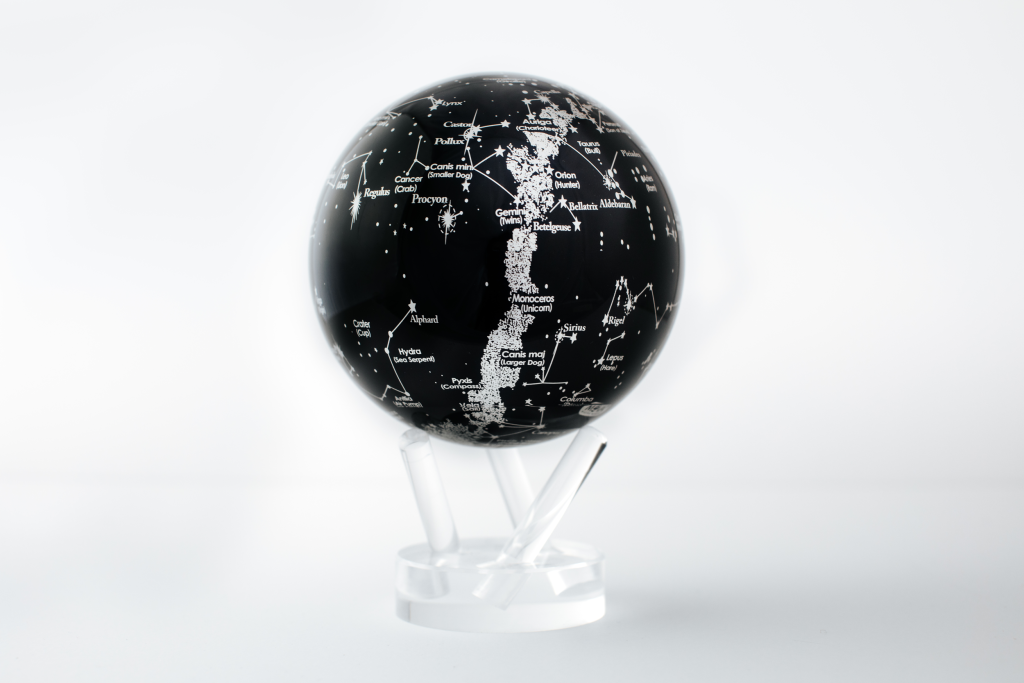
These three constellations are not the only ones that provide sailors with orientation at sea. In total, there are 88 named and recognized constellations, as seen on the MOVA Constellations Globe (see image above). Stars and constellations have long been a valuable navigation guide for explorers.
Round the Horn
Original nautical meaning: Before the Panama Canal, sailors had to sail around Cape Horn at the southernmost tip of continental South America. Modern meaning: Take the long way.
The most dangerous sailing route in the 18th century led around Cape Horn. Some would likely say it is still the trickiest route today. For the danger lies not in having rudimentary navigation instruments, but in navigating through a trifecta of hazards: strong winds, gigantic waves, and icebergs. The extreme low-pressure areas that plague the waters at the southernmost tip of continental South America, where the Pacific and Atlantic Oceans meet, create willow winds—frequent, sudden, unpredictable winds.
Many sailors who make it through the passage remark on the noise of the penguins or the dangerous ice accumulation on the ship’s deck. From Captain Cook’s time in the 17th century until the completion of the Panama Canal in 1914, navigating around Cape Horn was considered a rite of passage for the toughest sailors.
In the modern epic about the port city of Marstal, Denmark, We, the Drowned by Carsten Jensen, Knud Erik declares: “But you only become a real sailor when you have rounded Cape Horn to the south.”
When Your Ship Arrives
Original nautical meaning: Companies that invested in merchant ships took big risks and reaped big rewards. They watched for their ships (and with it, their fortunes) to return and pay off. Modern meaning: Hope that one will soon have good luck or fortune.
If you feel inspired to take a time travel journey into the age of sailing, we recommend embarking on an adventure by navigating around the world with the MOVA Antique Terrestrial Globe, guided by the MOVA Constellations Globe in a book rather than up close (Original nautical meaning: Wooden fort-like structures on the quarterdeck of merchant ships used for protection against pirate attacks. Modern meaning: A cramped space that offers little or no privacy) of an 18th century wooden sailing ship.
Recommended Books:
- Billy Budd: Herman Melville’s first novel (actually a novella), published posthumously.
- In the Heart of the Sea: A true historical book by Nathaniel Philbrick about the tragedy of the whaling ship Essex. The events in Essex inspired Melville to write Moby-Dick.
- We, the Drowned: A novel originally written in Danish by Carsten Jensen, which follows generations of sailors from a small town in Denmark and even includes a series of cameo appearances by Captain James Cook.